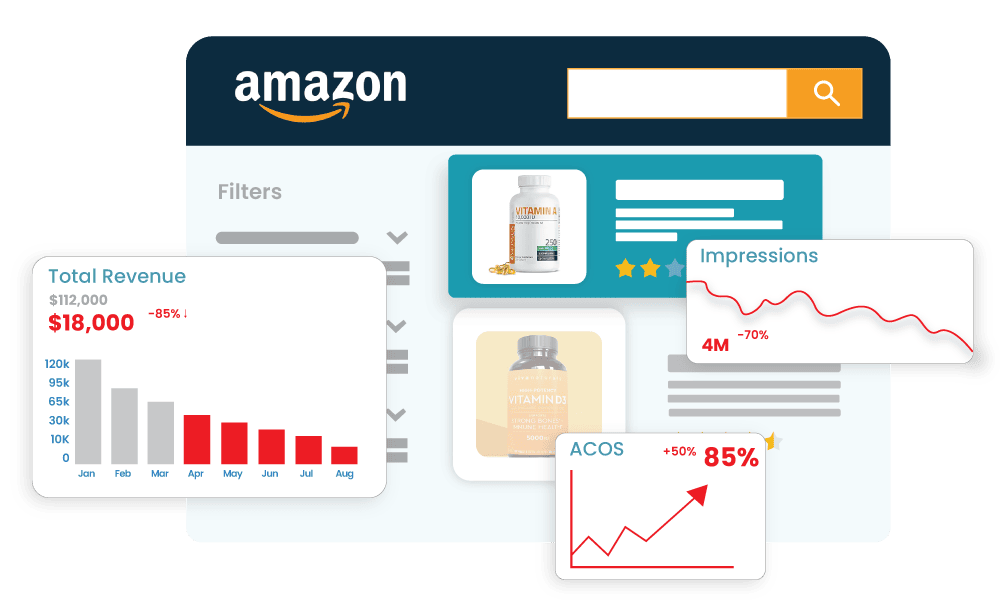
Rising auction competition and “set-and-forget” habits are the two amazon ppc cost optimisationmost common reasons Amazon advertising budgets creep up over time. The good news is that lower Amazon PPC costs doesn’t have to mean shrinking sales. The goal is amazon ads cost control: cutting wasted spend while protecting (or even improving) the parts of your account that reliably generate profitable orders and organic momentum.
Below is a practical, expert playbook for amazon ppc cost optimization built around Amazon’s own documentation and the optimisation levers Amazon gives advertisers inside Campaign Manager.
1) Start with a profit-based target, not a platform metric
Before you touch bids, define what “efficient” actually means for your catalogue.
- Break-even ACoS / ROAS guardrail: Build your target from contribution margin (selling price minus COGS, Amazon fees, fulfilment, returns allowance, promos). This creates a hard line for what you can afford.
- Portfolio-level targets: It’s normal to run different targets by lifecycle:
- Launch/defence terms: accept higher ACoS temporarily.
- Mature, high-converting terms: target efficiency and scale volume.
- Clearance/seasonal: prioritise sell-through.
Amazon’s rule-based bidding literally works on this concept—you set a performance goal (e.g., ROAS) and Amazon adjusts base bids per impression to try to achieve that target.
Why this lowers costs without killing growth: you stop optimising for vanity KPIs and start optimising to the economics that keep you in stock, competitive, and scalable.
2) Fix conversion first: the cheapest click is the one that converts
If your product detail page is weak, every PPC “saving” tactic turns into a sales decline. Better conversion rate reduces your effective cost of sale even if CPC stays flat.
Focus on:
- Main image clarity and compliance
- Strong title readability and key attributes
- A+ content (where available) and comparison tables for range selling
- Review quality/quantity (within Amazon policy)
- Price parity vs competitors and subscription/promo strategy
Amazon explicitly frames optimisation as a combination of campaign controls and strengthening product detail pages as part of Sponsored Products best practice.
Cost impact: Higher conversion rate increases ROAS, letting you keep visibility while you reduce amazon ad spend through tighter targeting and smarter bidding rather than just slashing budgets.
3) Use automatic campaigns as a discovery engine (then “graduate” winners)
Many accounts overspend because they never separate discovery from performance.
Amazon recommends starting (or supplementing) with automatic targeting to learn how shoppers discover your product, then moving top performers into manual targeting after the auto campaign has run long enough to collect meaningful data (Amazon suggests about two weeks as a guideline).
A clean structure that scales:
- Auto (discovery): low-to-moderate bids, tight negatives, harvesting.
- Manual (performance): exact/phrase keywords and product targets for proven converters.
- Brand defence: your brand + key product terms, controlled bids.
- Competitor/category conquest: product targeting with strict efficiency rules.
Cost impact: Auto collects demand signals; manual concentrates spend on what works—one of the fastest ways to improve Amazon PPC ROI.
4) Mine the Search Term Report weekly and add negatives aggressively

This is the single most reliable tactic to lower Amazon PPC costs without harming sales.
Amazon states that Search term reports help you identify high-performing customer searches and create negative keywords or product targets for search terms that don’t meet your goals.
What to do every week:
- Pull Search Term Report (last 7–14 days; longer windows for low-volume ASINs).
- Identify:
- Spend with no sales (or poor ROAS beyond your guardrail)
- High CPC queries with weak conversion
- Mismatched intent (e.g., “free”, “replacement parts”, “bulk”, wrong size/material)
- Add:
- Negative exact for specific waste terms.
- Negative phrase for patterns that consistently waste spend.
Amazon clarifies negative keywords can be used with phrase and exact match types, and defines how negative phrase blocks queries containing the complete phrase (and close variations).
Cost impact: This directly reduces wasted clicks, arguably the purest form of Amazon ads cost control.
5) Match types: use broad to learn, exact to scale profitably
If your account leans too heavily on broad match in “performance” campaigns, you’ll keep paying for loosely related queries.
Amazon documents how match types work, including that exact match is the most restrictive and can be more relevant to a search.
A practical split:
- Broad: discovery only (or very controlled, with heavy negatives)
- Phrase: scaling “families” of intent while still maintaining relevance
- Exact: your profit engines. Raise bids here (selectively), not everywhere
Cost impact: You maintain volume by scaling exact winners while broad continues feeding the pipeline at controlled risk, helping you reduce amazon ad spend without choking growth.
6) Choose the right bidding strategy for the job
Amazon gives you multiple bidding strategies, and the “right” one depends on whether you’re discovering, defending, or scaling.
Key options include:
- Dynamic bids – down only: Amazon will reduce bids when clicks are less likely to convert (it can decrease bids by up to 100%).
Use when: you want built-in downside protection for discovery or volatile targets. - Dynamic bids – up and down: Amazon can raise bids when conversion is more likely and lower them when less likely.
Use when: you have strong conversion signals and want Amazon to lean in. - Rule-based bidding: set ROAS (or similar) guardrails and let Amazon adjust base bids per impression to pursue the target.
Use when: you’re scaling a large catalogue and want automation tied to economics.
Cost impact: Using “down only” (or rules with guardrails) on discovery prevents runaway CPCs while exact/performance campaigns can be more assertive when justified by conversion.
7) Control placements like a trader: pay more only where it pays back

Placements are one of the most underused levers for amazon ppc cost optimisation.
Amazon explains you can adjust bids by placement and define increases for placements such as Top of search (first page), Rest of search, and Product pages.
A proven approach:
- Pull placement performance (or use reporting views) and look at ROAS/ACoS by placement.
- If Top of Search converts significantly better, consider:
- Lower base bids slightly (to reduce average CPC)
- Add a controlled Top of Search multiplier to concentrate spend where it converts
- If Product Pages are expensive and low-converting, reduce exposure:
- Lower base bids for those targets or split campaigns so you can manage modifiers cleanly
Cost impact: You stop overpaying for low-quality inventory while still winning high-intent placements, exactly how you lower Amazon PPC costs while keeping sales.
8) Expand product targeting to find cheaper conversions (and defend your own pages)
Keyword auctions can get pricey. Product targeting (ASIN/category/brand) often opens up pockets of efficient traffic, especially when you target complementary products or slightly weaker competitors.
Amazon describes product targeting as manual targeting that lets you target specific products, categories, brands, or other relevant product features.
Use cases that typically improve efficiency:
- Competitor conquest on listings with weaker reviews, weaker images, or higher price
- Complementary ASINs (accessories, refills, add-ons)
- Defence: target your own ASINs to protect the buy box area and retain traffic
Cost impact: You diversify away from the most competitive keyword auctions and often improve ROAS—helpful when your goal is to improve Amazon PPC ROI.
9) Keep budgets from limiting growth, without throwing money at everything
Cost cutting fails when high-performing campaigns run out of budget early in the day, forcing you to spend in less efficient places later.
Amazon’s budget rules are designed to help high-performing campaigns not run out of budget and to plan budgets around holidays and sales events.
Practical guardrails:
- Increase budgets only on campaigns that beat your efficiency target.
- Cap spend on “learning” campaigns; don’t let them cannibalise proven winners.
- Use event-based rules (Prime Day, Black Friday, seasonal peaks) for controlled scaling, then revert.
Cost impact: This is amazon ads cost control with a growth mindset: money moves to what performs, not what shouts the loudest.
10) A simple weekly optimisation routine (that actually lowers spend)
If you want consistent results, make optimisation boring and repeatable:
- Search term harvest (weekly): add negatives; promote winners to exact.
- Bid hygiene (weekly): reduce bids on targets above your ACoS guardrail; increase selectively on exact winners.
- Placement check (fortnightly): adjust modifiers based on ROAS by placement.
- Creative/listing upgrades (monthly): run conversion experiments that reduce cost-per-order.
- Structure cleanup (monthly): separate discovery vs performance so you can scale profitably.
The bottom line
To lower Amazon PPC costs while maintaining sales growth, you don’t “cut ads”—you cut waste. The reliable path is:
- tighten targeting with Search Term Reports and negatives,
- scale proven intent via match types and manual campaigns,
- choose bidding strategies that protect efficiency,
- and control placements and budgets so spend follows performance.
Do that, and you’ll reduce amazon ad spend in the places that don’t convert, while still funding the campaigns that drive both paid sales and the organic lift that sustains long-term growth.
If you want, paste a quick snapshot of your current structure (campaign types + ACoS/ROAS ranges), and I’ll suggest a cost-reduction plan that fits your catalogue and margins.
If you’d like hands-on support to accelerate results, whether that’s tighter amazon ppc cost optimisation, better amazon ads cost control, or a plan to improve amazon ppc roi while you scale, Lezzat can help. Get in touch with us, and don’t forget to explore our other blogs and case studies for more practical strategies, real-world examples, and proven frameworks you can apply to your own Amazon account.